The number in science and culture
The comet behind a May meteor shower
2004 · 209P/LINEAR
The LINEAR survey discovered periodic comet 209P/LINEAR in 2004. When Earth met dust the comet had left in space, the debris produced the May Camelopardalid meteor shower.
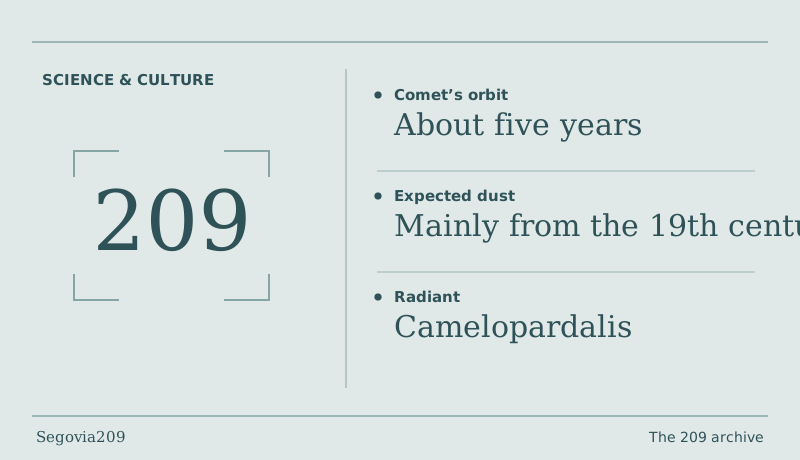
The comet follows a path that takes it inside Earth’s orbit roughly once every five years. For the encounter in May 2014, calculations indicated that Earth would cross material shed largely during the nineteenth century.
Astronomers could reconstruct the path of the dust more confidently than its quantity. The shower takes its name from its radiant, the point from which the meteors appear to spread, in the faint constellation Camelopardalis, the Giraffe, near the Pole Star.
- Comet’s orbit
- About five years
- Expected dust
- Mainly from the 19th century
- Radiant
- Camelopardalis